Blog

SPACE: The First frontier. Reflections one year on with The Loss Foundation

It’s been just over a year (388 days to be exact) since I first started volunteering as a group facilitator at The Loss Foundation. It seems odd looking back at that first session now, back in the sofa shop in Southwark, how it ended up being the Foundations last face-to-face session, and how far removed it seems from todays reality. I think it would be fair to say there’s not a single person, certainly in the UK, that hasn’t been effected by the pandemic in some way over the last year. Whether it’s through being furloughed, losing a job, moving home, being ill with the virus or losing someone during this time, I would go as far as to say in fact that the pandemic has not only changed our way of living, but also completely redefined our meaning of loss. This redefinition has not only exposed just how vulnerable we are to loss, grief and bereavement, but also how ill equipped we are as individuals and as a society to cope with loss, whether that be in a physical, emotional or metaphorical sense of the word.

With so many people experiencing loss over the last year, not just through loss of life, but also jobs, livelihoods, routines and dreams, one question has gone through my mind repeatedly: how do you support someone experiencing loss, grief and bereavement? After a year of volunteering with The Loss Foundation, and 19 sessions under my belt, I feel as though I may be getting closer to understanding an answer to that question. Space.

Let’s get real for a moment: loss is traumatic. The process of losing a loved one, whether family or friend, is traumatic regardless of the cause of death. The very idea of loss is that it’s something you will never get back, and having to confront that thought, and it’s wide ranging impacts on your life is complex, challenging and will fundamentally change you for ever. And yet, loss is perhaps one of the most essential parts of life. It’s something we will all experience multiple times – so why are we so collectively bad at handling it? Well, that’s a political and structural conversation for another blog, but I will say that until we can have an open conversation about loss, grief and bereavement, both on a personal and collective scale, wider support and understanding will be harder to achieve.

Providing a space for people to come and discuss their loss, grief and bereavement in a non-judgemental way has powers I still struggle to cohesively put into words. There is no magic trick, no clever sentences, in fact most of the volunteer facilitators hardly say a word during the support sessions. And yet, providing that space for people to be able to sit with their loss, acknowledge it and hear from others going through vaguely similar things seems to have, at times, overwhelming effects on those who decide to join the sessions.

So what is it about this space that seems to work so well? Firstly, as mentioned in the title, providing a safe space for people to come and be present with their loss is often the first frontier, or the first step that many take towards getting help with their grief. For many people that attend The Loss Foundation sessions their grief is still very raw, especially with the coronavirus loss groups. For others, they may have felt like they “dealt” with their grief in the period after loss, to only find it rear its head again a few years later. Therefore, providing a space where people can come, express their thoughts and feelings regardless of how culturally taboo, difficult to hear or hard to express they may be without fear of judgement is often the first step towards accessing wider support.

Secondly, in a world where physical connection is so limited, social and emotional connection has never been more important. Emotional connection is what makes us human, and being able to connect with others whilst going through traumatic events is one of the most useful ways of preventing the trauma from having a severe impact on the individual in the long term. One of the only silver linings of the pandemic is that it has forced organisations like The Loss Foundation to innovate, adapt and change with the circumstances. Sure, online support sessions will never be truly the same as face-to-face sessions, but in opening that avenue of care up, the Foundation has taken an enormous step towards reducing the postcode lottery of bereavement support and has helped to offer the simplest, yet most vital lifeline to thousands of individuals trying to cope with their loss. I strongly believe, and deeply hope that these changes will be permanent in some way, and look forward to seeing how the Foundation continues to adapt, innovate and change in the coming months and years.

I wanted to end this blog in a similar way to how I ended the first blog post I wrote for The Loss Foundation a few months ago: with some common themes of the sessions, how you can help support people coping with loss, and how you can support yourself if you’re in need.

Common Themes:

  • Guilt: Perhaps one of the sentences I have heard the most during the last year with The Loss Foundation is “I feel guilty for feeling this way”. Often, attendees of the group sessions express their feelings of anger, and even jealousy towards their friends who may not be experiencing the same grief or loss as them. Despite the shame and guilt that is normally attached to these feelings, many people fail to understand just how common and how valid these thoughts and feelings are. Wishing other people could experience what you are experiencing does not make you a bad person. In a world not designed to manage loss, it can be hard to process feelings of grief when we’re constantly reminded of how others may not be experiencing the same thing. Feelings of jealousy or anger do not mean you genuinely wish harm on others, but are more often a reflection of the acuteness of your loss and the difficulty we all have in trying to reach out for help. Often, simply expressing these thoughts and feelings in a non-judgemental space is one of the best ways to put them to rest, and you may be surprised just how many other people listening also feel the same way.
  • None of my relationships are the same: Loss always creates change. When there’s a gap in our life we naturally try to fill it, so it’s understandable that this shake up can create friction with our relationships in our lives. A frequently recurring theme in the support sessions I have attended has been one of difficulty navigating relationships, whether family, friend or professional after losing someone. Perhaps you lost a parent, and now feel the need to step in to the “mother figure” role. Perhaps you lost a friend who was like the glue holding your friendship group together, and now have to be the one to ensure that group doesn’t fall apart. Whoever you have lost, the tension that exploring these new relationships can cause often leaves people frustrated, angry and even more acutely aware of their loss. Perhaps one of the hardest things to do in this situation is acknowledge that those relationships have changed forever. This is hard both because you are adding an additional loss of the relationship you had before, but also because you are then accepting the reality of the loss you originally experienced. In these situations, what I have heard suggested by group members is to be open. Talk to those people you are struggling to forge a new relationship with and name the problem. Acknowledging this will help both parties to understand where the issue is. Secondly, give yourself time. Loss, grief and bereavement have enormous impacts on our life, and trying to process all of those impacts at once is impossible. Give yourself time and space to work through things when you feel ready.
  • I can’t remember the happy memories: Something i’ve heard mentioned a few times recently is this inability to remember the happy memories of the person that has died, whether that’s because the memories are too painful to bring up at the moment, or because the trauma of the loss was so acute that it has blocked all other memories out. Whilst this is a completely common feature of trauma and loss, it is also worth noting that these issues have been particularly accentuated during the pandemic, where many of us have been shut off at home, left with intrusive thoughts and no distractions, or reminded of the trauma of loss through the news etc. Sadly, there is no quick fix to this. Many group attendees say how it took them a long time to be able to think of the happy memories they have of their loved one. What I would say is though, that even though it may take time, it will happen at some point. Some people find the process of sorting through their loved one’s possessions useful in helping this process, others find it useful to speak to friends and family about their own memories. Others find it useful to just give themselves time and space until they are ready to go back in to their own memories. What I would say is this: remember you haven’t lost the memories of that person, or the experiences you had with them. They will always be there for you, whether in your head, in your home with possessions or with your friends if they also have cherished memories. Allow yourself time and space and try not to rush into remembering happy memories, it’s an individual process that takes time.

How you can help:

  • Listen: Just listening can be an amazing way of supporting someone going through bereavement and loss. Try not to be judgemental, and try not to tell people how they should or should not be feeling. Loss is an individual thing, we each manage it and approach it in different ways. So long as the person is safe, allow them the opportunity to figure out how they wish to manage their loss.
  • Put the person first: Some people like to be asked about their loved one, some people don’t. Some people like to talk in detail about their feelings, some people don’t. It may seem hard at first, and we often jump to cliched phrases like “sorry for your loss” and “let me know if you need anything”, but actually sitting with the person and asking them what you can do to help, or whether there’s anything they would like you to avoid doing, can make a world of difference.
  • Be sensitive: Anniversary’s, special days and other life events can be challenging for those who are grieving. Be sensitive about their feelings. Ask them first if it’s ok to post that picture of their mum on what would have been her birthday, check in to see how they’re doing (this should be all the time, but at the very least when you know difficult life events are upcoming), and respect their opinions and wishes if they ask you not to do something. We all process grief in a different way, and most of the time our actions of support come from a place of love. But in many instances our actions can make those occasions even harder for those people, so just be sensitive. And if you’re in any doubt: ask that person.

How you can help yourself:

  • Be kind to yourself: Need that day off work? Take it. Need to speak to a professional? Call them. Need a break from other people? Take it. Whatever it is (so long as it’s safe) that makes you happy and brings a bit of self-kindness to your life, try and do it. Loss is traumatic, therefore you need to be even more proactive in looking after yourself wherever possible.
  • Reach out: Ask for help. Whether it’s through the Samaritans (116 123), The Loss Foundation, or any other support services, know that you’re not alone. There is so much help out there, you just need to reach out and grab it. This is unbelievably hard to do, but please know that there are people who care that are ready to help!
  • Be honest: If you don’t feel able to have a conversation with someone on that day: tell them. If someone has done something that has upset you: tell them. Having honest conversations with people is often the best way to clear up what are normally just misunderstandings. So long as everyone remains as calm as possible, being open and honest about your feelings can be a massive relief both to you, and often to those around you. None of us really know how to talk about death, we’re not taught it and it’s not part of our cultural makeup. But being open and honest, regardless of how uncomfortable that may feel in the moment, can help others to understand how you’re feeling and how they can better support you.

Whilst this last year has taught me a lot, I do not even slightly pretend to know everything about loss and grief, but I hope, through attending more sessions at The Loss Foundation that that understanding will grow. As ever, I want to thank all my fellow volunteers and friends at The Loss Foundation, and all the attendees of the group sessions. Your ability to be open and honest about your grief has taught me more than any psychology book could, and I am extremely grateful.

Disclaimer: Please note, all the opinions written in this blog are my own and therefore The Loss Foundation is in no way accountable for what is written.

It’s a new dawn… It’s a new day… It’s a new liiiiife for me… and I’m feeeeeeling… meh?

2021. What a year so far. After the 7,000 year long 2020, this year promised so much: a vaccine, the opportunity to once again hug family and friends and the chance to confine the horrors of 2020 to the history books. But 2020, and more depressingly COVID, wasn’t quite done with us yet. Now I’m not here to write off an entire year only 5 days in, more to update you all on how I am personally feeling (because I know you all want to know), and how I feel that the start of 2021 should be approached.

Almost 10 months after writing my “how to keep calm and quarantine” blog, and after a 7 month hiatus, I thought I would write something of a follow up blog post on how I have coped mentally over the last 10 months and share with you some life mantras that are helping me at the moment.

As I’m sure you’re all aware by now, we are now in lockdown 3 in the UK (? I think, I stopped counting) and the last 12 months have certainly taken their toll on people’s mental health. In my own case, the constant changes both on a personal and on societal level have left me at such a constant level of anxiety that I’ve almost become numb to it. I know from conversations with many friends and colleagues that I am not alone in being stuck in this horrible no-mans land, not at baseline, but not at burnout either. The distinct feelings of panic, fear and anxiety present throughout the first few months of the first lockdown seemed to have boiled down to residual hopelessness, and perhaps most shockingly, a resignation to accepting our new fate without questioning how we got here, why we’ve come to this or when we’ll properly see an end to it all.

Now, if you too are feeling a similar way, as if it’s impossible to see the tunnel, never mind the light at the end of it, then bear with me, because below I’m going to set out some ways that I’ve been trying to change my own status quo and drag myself out of this cycle of “meh”. This is also not to say that those experiencing other feelings, either of baseline or burnout are not as equally as valid, of course they are, and many many people are experiencing them, BUT, I haven’t personally experienced those feelings for a while so I’m not going to pretend to know what to write about managing them in the current world.

  • You. Do. YOU

First and foremost, you need to look after yourself, whatever it takes. If it means sleeping longer, sleep longer. If it means watching more TV, watch more TV. If it means exercising more, exercise more. We all have our own coping mechanisms, and a global pandemic is not the time to go changing them unsupervised. Of course, as is the case with everything in life, excess can cause more harm than good, so be careful not to over indulge. That being said, after a long day, where you’ve been under immense mental stress or felt blue, don’t judge yourself for doing things that make you feel better – so long as you’re SAFE!

Focussing on your own mental health is not selfish. It’s not attention seeking and it’s most certainly NOT a sign of weakness. Looking after your own mental health not only ensures you are comfortable, safe and happy, but it also gives you a much greater capacity to help others, so in fact it’s the opposite of a selfish act. Despite this, many people don’t know how to, or don’t feel able to look after their own mental health. This is completely understandable and extremely common and there are some fantastic resources available online with tips and tricks so I recommend searching them out.

  • Don’t do everything at once

One of the main reasons I’ve been getting bored on my own in my flat is because I’ve been doing things too quickly. Writing myself a list of things to do, chores, activities, work based things etc, and then finishing them all in 3 hours. This is an old habit that I’m sure I’m not alone in struggling to shake. Pre COVID, life was fast paced, there were dozens of things I never had time to do in the day, so I felt like I constantly had to rush. In fact, this sense of being “busy” or in a rush somehow gave me purpose, as if the number of tasks I was able to complete during the day somehow defined my capability as a functioning member of society.

Well, much like in the last season of The Good Place, take it slow. Do the things YOU want to do. Had a boxset you wanted to watch but didn’t have the time? Watch it. Not all in one go, but over a couple of weeks. Had some DIY you wanted to do round the house? Do it. But not all in one go, take time to enjoy it. I’ve found that slowing down my approach to daily tasks has greatly increased the amount of pleasure I’ve gotten out of completing them, as I’ve not felt pressured or rushed. This will also greatly help break up work from home days if you’re stuck in your home all day long.

I for one have a wall that needs stripping and treating for damp and mould. I plan on spending 2 weeks doing it. Why? Because I can. Because there’s no rush. Because actually, having a wall to strip and treat gives me a reason to leave my desk for 5 minutes every now and then. Leaving myself small tasks to do throughout the day has been an amazing way to break up my screen time and give myself a rest from work every now and then and when you do eventually complete the task, the sense of gratification is far greater as it’s something you really invested time in.

  • Manage those expectations

Hey you. Ye YOU. The fact that you’re here reading this right now is amazing. It means you made it. Somehow, you clawed your way through one of the most challenging years the world has experienced for a generation when many people sadly did not. Setting yourself incredibly high expectations for where you should be in life right now, whether that’s on a personal, professional, academic of financial level is unrealistic and dangerous. Ultimately, there isn’t a score card in the sky (I don’t think) where someone is tracking what percentage you scored in a test, or how much you get paid, or how many new friends you make. Getting through a day during the first global pandemic in a century is a massive achievement, and if it’s the only thing you manage then good for you. If you manage more, great. But don’t set it as an expectation every day, because then you’ll only be mentally kicking yourself harder when you’re feeling down and you don’t meet said expectations.

Just as you shouldn’t set high expectations of yourself, don’t set high expectations of others. The last 12 months have impacted every single person on this planet in some way, and we can only ever speculate as to how. Giving people the time and space to figure this horrifying world out is the ultimate act of kindness and the easiest one to perform, so do it. Regardless of whether you personally think a person is having an easier time than you.

I’m not saying never hold people accountable for what they say they’ll do, or set yourself goals and aspirations, but try to be mindful of what control you have as an individual on yourself, others and the wider world, and tailor your expectations accordingly.

  • Engage

Whether it’s nature, art, music or sports, engage in something that brings colour to your day. It costs nothing to walk round the block and seek out nature, whether it’s in a city or the countryside, nature is there if you look hard enough. As for art, music and sports, I know we can’t witness these things live at the moment in person, but you can still seek out art online, or on streets in murals and posters, you can still listen to music whilst working or walking or relaxing and you can still watch sports or even participate if you don’t live alone (although I had a disco for 1 on NYE and still danced to my hearts content!).

The most important thing about engaging in culture and the environment is that it not only provides that colour to your day, but it is a fantastic distraction and an opportunity to mentally press reset during challenging times. None of these things ever went away, the means of us accessing it all just changed. I personally find nothing more mentally restorative than walking around the park in the evening when its quiet with my earphones in listing to music and making an effort to be present in my surroundings and appreciate as much detail as possible.


This year is going to be a hard one, and after the challenging one we’ve all just had it’s no wonder so many people are struggling. BUT, please know that you aren’t alone. You are remarkable for making it this far and we WILL make it through this if we all look after ourselves and each other.

Finally, to those who have lost loved ones, as so many have, I send you all the love and solidarity I can muster during the most challenging of times, amidst the most surreal global event.

From Cancer to Coronavirus: How the world is crying out for support, and who is answering

Every day now for what seems to have been a lifetime length of 3 months, announcements have been made on the number of new cases, hospitalisations and deaths for the novel coronavirus (COVID-19) in the UK daily briefings. Noticing that merely reading these numbers comes across as cold and robotic, the politician chosen to front the briefings normally adds a small emotional caveat such as “behind each of these numbers is a family who’ve lost a loved one”, or “our thoughts and prayers are with the families and friends of those who’ve died”, before swiftly moving on to the daily updates as to the measures they are putting in place to try and stop the virus.

Whilst the emotional caveat is consistently used, one begins to wonder whether it is fully understood by the politician using it or the public hearing it, or whether the daily usage of such sentences mentioned previously has actually helped to normalize something which, despite being the inevitable ending of every life cycle, still remains one of the hardest things to confront and go through: death and loss.

Of course, death is inevitable, it is something we will all encounter multiple times in our own life before it is eventually the thing that takes each of us. For many though, the thought of death, loss and grief presents an uncomfortable challenge of dealing with life in a completely different way socially, emotionally and physically. This challenge often leads people to turn away from confronting these realities, instead repressing their thoughts and feelings, which can lead to prolonged and accentuated trauma for the individual. Despite the inevitability of death and loss, specialist bereavement support remains relatively minimal in the UK, and the conversation has yet to be had properly about how we educate children, adults and the elderly about the concepts of death and grief. This in turn, has led to generation after generation being left utterly bereft of adequate coping strategies and knowledge around the impact of death on families, friends, careers, social lives, finances, physical and mental health amongst many other other things.

Killing ONE IN FOUR people in the UK every year, Cancer remains one of the most common causes of death in the UK, and yet, despite first being mentioned in ancient Egyptian texts in 1600BC, and being widely referred to as a common cause of death for the last four hundred years, there is only ONE specialist cancer bereavement support charity in the UK: The Loss Foundation. This statement alone should be a call to action to any researcher, psychologist, therapist or policy maker to make a change in the way in which death, grief and bereavement support is approached in the UK and across the globe, never mind the fact that most grown adults still struggle to have a rational conversation about cancer, loss and the process of grief.

Founded in 2010 by Dr Erin Thompson, The Loss Foundation has been committed to providing free, open face to face group spaces for individuals who have lost a loved one to cancer. These face to face group sessions allow bereaved individuals to come and discuss their thoughts, feelings and whatever they feel is weighing heavy on their mind. In addition to the group sessions, the Foundation also offers therapy sessions and cancer bereavement retreats. Their taboo free spaces where all vibes are welcome and no discussion is irrelevant or discarded, have helped many hundreds of individuals to confront their grief and find companionship through friends and facilitators. Given its status as the UKs only specialist cancer bereavement support charity, it came as no surprise when The Loss Foundation also became the UKs only Coronavirus bereavement support charity.

How then, can Cancer bereavement support continue, and Coronavirus bereavement support begin, given the inability to hold the monthly in person group sessions The Loss Foundation have become so used to holding due to the lockdown restrictions? Simple, through the medium of the internet. Over a mammoth month of hard work, group meetings and trial runs, The Loss Foundation transitioned all of their support groups to operate remotely via platforms such as Zoom by April. With a provisional group size of 12 participants and 3 facilitators, I was anxious to see how the new way of facilitating groups would play out. Would there be internet problems? What would we do if someone was getting extremely emotional and we were unable to support them through the usual means of comforting? How could we ensure that every individual that attended the group would be able to have their chance to say what was on their mind? All of these questions, plus many more, were ones that I and my fellow facilitators, and the team at The Loss Foundation have constantly explored with each session, based on facilitator and participant feedback.

What has become increasingly apparent is that, despite the difficulty of lockdown and the additional level of surrealism that the pandemic has added to the way in which people are grieving, many common themes still remain as points of discussion in the online groups. Below I will lay out a few of these themes that commonly occur, how I personally feel they can be managed and how I feel the pandemic has impacted these themes. These are my thoughts and feelings and whilst I am a facilitator at The Loss Foundation these are merely reflections, not advice on their behalf.

  • “I don’t feel like i’m making any progress in my grief”

The process of grieving is a complex and individual one. One of the biggest misconceptions is that the process of grief follows a stage like model. This model is commonly known as “The 5 stages of Grief Model” proposed by Kübler-Ross and consists of Denial, Anger, Bargaining, Depression and Acceptance. Of course, all of these “Stages” contribute to the process of grief, but to say the grieving process follows a linear progression is unhelpful and leaves many individuals feeling like they are grieving incorrectly, or somehow not meeting some preset schedule of when they should be going through each stage.

A more helpful way of conceptualising the process of grief (and the one most favoured by The Loss Foundation) is the “Dual Process Model” proposed by Stroebe and Schut. This model considers grief to be less of a linear process, but instead a process of fluctuating between two common states of being Loss-orientated or Restoration-orientated. This model is considered far more helpful in getting to grips with grief, as instead of expecting individuals to follow generic stages, the focus is more around helping to understand how individuals can fluctuate between the two states mentioned above over many years. Whilst this removes the hope that the process of grief will ever be “over”, it does provide validation to those who still suffer the pain of loss several years after the actual loss occurred.

This way of approaching grief has become increasingly important during lockdown, as many participants attending the online sessions have mentioned a renewed sense of grief and loneliness during the period of physical isolation, despite having lost their loved one many years before. My advice to anyone reading this that is going through loss is to check out the model and forgive yourself for not meeting the unrealistic targets of ending your grief after 5 stages, and for revisiting areas of grief even after you thought you were done with them.

  • I’m struggling with my mental health for the first time in a long time/ever”

Depression, anxiety and many other common mental health issues are of course very common traits of grief and trauma, but it has become increasingly apparent that these issues have been blown enormously out of proportion during the period of lockdown. For many people, lockdown has been the first time they have ever experienced mental health issues such as anxiety and depression. For others who may have lost a loved one some years ago and experienced mental health issues during their initial period of grief, lockdown has been the first time in years that they have felt these feelings of panic, worry or sadness to this degree.

Speaking as someone who suffers regularly from panic attacks and has seen their own mental health deteriorate during lockdown, I wanted to share some easy self-help strategies I, and many others I know, use regularly.

First: Stop trying to rationalise the irrational. Reflection is a wonderful thing when done properly, but can have dire consequences when left to spiral unchecked. Anxiety by definition is the irrational fear of perfectly rational things. These things don’t always have to consciously worry you, and can often be things that you were previously never worried about. Stop trying to wonder why these things now worry you, this is not an important thing to do right now. Focus on ensuring you are physically safe and try to find things that will help you to calm down should you experience a panic attack. The easiest method of calming yourself during a panic attack is through the use of simple breathing techniques, such as the one below.

Second: Only reflect if you feel capable of doing so and only allow yourself to reflect for short periods of time to start with (eg 5 minutes). We are a very solution driven society, so it can be frustrating to be feeling depressed or anxious and to not know how to “solve” those feelings. Often this frustration leads us to delve into our past to try and logically think back to when the episode of depression or anxiety began. This process of reflection can be mentally dangerous, especially if you are already in a vulnerable position. Mental health workers and clinicians spend years learning how to reflect in a positive and constructive way, and still many struggle to avoid feeling anxious or depressed when looking into their past. Some helpful ways I’ve found to reflect are as follows: Write down one broad thought as a question, such a “how long have I felt like this”, start a timer and allow yourself 1 minute to think of an answer and write it below. Once the minute is up, put the paper that the question is written on in a place away from sight. Do this for a maximum of 5 questions and then go to do a distracting activity, such as watching TV, reading, cooking or spending time outdoors. This short burst of reflection should put your need to find answers as to why you are feeling the way you are to bed at least for the day, and will allow you to reflect without tumbling off a cliff and getting lost in endless anxiety/depression inducing reflective thoughts.

Refer back to the breathing techniques mentioned above, and as always, if you notice that your are struggling and need help, use the Samaritans hotline on 116 123

  • “I feel guilty”

The word guilty has been possibly one of the most frequently occuring words i’ve heard whilst facilitating sessions at the loss foundation since joining them in January. There are many reasons why people feel guilty, many of which often appear to be seen as logical reasons to feel guilty on the surface, until the deeper meaning is unearthed.

One of the most common reasons people seem to feel guilty is as a result of them wishing that the people they come into contact with were also experiencing their grief. On the surface, this seems a sinister and anger driven feeling that is “wrong” because it is wishing ill on others. But when you delve further into why individuals who are grieving so often wish their grief on others the reasons quickly become ones of desperation and a lack of understanding from their peers.

When trying to console individuals who have lost a loved one, many stock phrases such as “I can’t imagine what you’re going through” or in some cases as mentioned above “your in my thoughts and prayers” are commonly used. Whilst these are well intentioned offerings, the delivery can often result in feelings of further upset as bereaved individuals try to project their feelings onto you so you truly can feel how they’re feeling, or they try to process how thoughts and prayers will help them through the pain of loss. The fact is, in this instance, no one is to blame. The individual offering help is merely doing their best given the limited level of wider general knowledge that most people have around death and grief, and the bereaved individual is trying to process something they are not equipped to process in a world not designed to help them.

In these instances of guilt there is one thing I have heard my fellow facilitators say repeatedly, be kind to yourself and to others around you. Your guilt comes from your decency as an individual and the knowledge that had you not been in the surreal circumstances of going through grief, you wouldn’t wish ill on anyone. Therefore, try to find spaces where you can express these natural feelings and thoughts, whereby you wont risk hurting the feelings of those trying their best to help you, but importantly wont hurt yourself by not allowing yourself to think very natural and acceptable thoughts.

And to anyone reading this who is trying to support someone through the process of grief, sometimes not saying anything says a thousand words. To be frank, there are no words or stock phrases that will ever come close to bringing someone back from the dead or properly consoling those who have suffered a loss, all we can do is try to be there to listen and support where we can. Always try not to judge and try to remain neutral in your use of language, often people who are grieving just need a platform to share their opinions and feelings in order to help them process them without fear of judgement or upset. As always, if you notice someone you are supporting is struggling, call Samaritans on 116 123


Whilst there are many different topics that have arisen over the last 4 sessions and 1 walk that I have helped to facilitate, I feel that I could write forever about my experiences and I’m very aware that this is already a mammoth reading task.

What I would like to highlight is that, despite this being a period of physical isolation, the need for social connection has never been greater. I am extremely grateful to be a tiny part of such a fantastic organisation as The Loss Foundation, and I have been overwhelmed as the enormous need for free, high quality and frequent bereavement support services has become apparent to me since joining the foundation in January. Whilst the numbers of COVID-19 deaths may be slowly decreasing day by day, the loss, grief and trauma experienced by those who have lost a loved one will never truly diminish, only possibly change shape over time. It is also important that whilst The Loss Foundation champions bereavement support for Coronavirus, it is also vital that the Foundation remains a constant for those who have lost a loved one to cancer, something I am confident will be the case over the coming months and years.

There is still so much to be said and done to increase the support for all these individuals I have mentioned above, but I feel assured that through the work of charities such as The Loss Foundation, and their contribution to research and the wider understanding of loss, progress will be made.

Will the real Pandemic please stand up

It’s safe to say that by now you probably know the reason behind me writing this blog post. It is, of course, the ongoing COVID-19 (Novel Coronavirus) pandemic. Almost 3 weeks ago I wrote a short blog which contained some simple tips and tricks as to how you can manage anxiety during the pandemic, and boy, what a lot has changed since then!

As the virus has taken hold of entire nations, we have witnessed cities, towns and villages become ghost towns, with only the odd person now milling around. This abrupt disruption of “normal” life left many people in a sense of confusion, disorientation and general fear. Almost two weeks down the line (for the UK at least), people seem to be slowly adjusting to the new “normal” way of life, albeit with extreme caution. The real question on my mind however is not “how long will this last” or even “will I catch Coronavirus” but instead the question of “what is the real pandemic here?” has been plaguing my thoughts.

Now, please don’t mistake me for a fool, I know the current pandemic we are all up against is COVID-19. What I mean with my question is, how, when the virus has such a significantly small mortality rate compared to other viruses currently out there, has it spread with such ferocity. Also, how has this virus managed to bring the Western world to its knees when other diseases such as Ebola didn’t even get close? Finally, how has this disease managed to ravage the Western world but, as of the time of writing, has caused significantly less damage across many lower-income countries in comparison to the awful ongoing battles they have against diseases such as TB, Malaria, Ebola and Cholera.

Upon reflection, I feel as though I have possibly come up with an answer. The real reason COVID-19 has managed to get such a foothold in the West, is because we have been suffering from a whole host of other Pandemics for decades without even noticing. I’m talking about the pandemics of inequality, common mental disorders (such as Anxiety and Depression) and greed. Now I know that most people in the scientific community may label these things as Epidemics, but I would disagree. By definition, all of the things listed above have spread across almost every Western nation (with the USA and UK at the forefront), with only a very small proportion of the population having any sort of “immunity”. Now I realise I am not the first person, and certainly will not be the last to recognise that the West suffers enormously with inequality, greed and the staggering presence of common mental disorders. BUT, in a situation such as the one we currently find ourselves in, it is these long standing “pandemics” which I feel are responsible for the spread of COVID-19, and I feel if anything good should come of this, it should be our ability to reflect better on our treatment and awareness of the struggles we already face and where they have come from. As such, I will break down each “pandemic” and you can let me know if by the end you also see how said “pandemics” may have led to this virus getting such a strong foothold.

  1. Inequality
    What was once considered “loony lefty liberalism” has, overnight, become policy. Despite being told for decades that “there are no magic money trees” and that homelessness cannot be solved overnight, both of these have been achieved not only at record pace but also by a conservative government (here in the UK).
    For decades, ever since the ending of WW2, the West has drifted further into being unequal, not just economically but also racially and on the basis of gender. It is not incorrect to say that the top 1% of Americans own more wealth than the bottom 50% put together. This vast void in financial equality has led to significant gaps in education, housing, social and health care. Similar chasms in equality can also be seen across every Western country, and it is only during these times of great hardship that such gaps are truly laid bare for the entire world to see.
    “Why is that?” I hear you ask. Well, from a cynical perspective, it’s because when a virus doesn’t discriminate based on age, gender, race or sexuality, a vast proportion of wealthy white men become extremely scared that their ivory towers and fortresses of money won’t offer them the protection they thought they would. It is at this point that they begin to panic and momentarily reverse their ill opinion of the “lower class” in a desperate plea for help. Note the use of the word momentarily. Please don’t be fooled into thinking that once this COVID-19 pandemic is over you will see record funding for the NHS, public services and the creation of an equal society.
    From a less cynical perspective it’s because of the transfer of power. As mentioned above, when a disease doesn’t discriminate, the value of money and possessions disappear. This can be seen as the entire global financial market has all but crashed, hitting a brick wall, and all it took was a matter of days and one virus, pretty scary right?! What does however increase in value is the worth of the individual. Just a few years ago, junior doctors were hounded off picket lines for wanting a fair wage and safe working hours. Now they are being praised as modern day heroes. In fact, only a few months ago our “delightful” home secretary Priti Patel announced a new, post-Brexit immigration rule which would classify anyone on below £24,000 a year as unskilled, meaning they would not qualify for a visa. Imagine the disaster we would be in now if that would have happened. Nurses, carers, mental health workers, shop workers, bus drivers, teachers and so on would all be classified as “un-skilled” and therefore worthless! Now, as with doctors, they are being praised for being the very people holding the fabric of society together.
    Be under no illusion, this new found sense of worth and transfer of power will not last long after the pandemic is over. Therefore USE IT WISELY! Vote well, know your worth and demand better from all of those who once told you you were insignificant, because when the time came, it wasn’t billionaires or tech giants that saved the world, it was the key workers.
  2. Mental Disorders
    For almost a century, the West has grappled with the worst pandemic it has ever faced, with common mental disorders (such as anxiety and depression) now thought to affect at least 1 in 4 people in the UK alone. To put into perspective the true enormity of the mental health pandemic the world faces, the WHO estimates that over 800,000 people worldwide die each year from suicide, that is equivalent to a virus 12.5x more deadly that COVID-19 (at the time of writing) sweeping the globe Every. Year.
    So why then do common mental disorders and investment in mental health infrastructure amount to such a small percentage of funding each year? Again, in comparison with COVID-19, the UK spends roughly £12billion per year on mental health research and infrastructure. That’s less than 3% of what has been spent so far by the UK on COVID-19.
    As highlighted previously, the current outbreak does require vast resources, and I am by no means critiquing the governments spending to try to stop the spread of the virus. BUT, as mentioned in the inequality section above, the vast amounts of spending on COVID-19 demonstrate that such amounts COULD have been spent on other areas in the past. “Why is this relevant to stopping COVID-19 though?” I hear you say. Well, because the main spreader of this virus is humans, and the main ways to stop the spread is social distancing, isolation and a complete change in human behaviour. “Who knows about human behaviour and how it can impact whether we adhere to government guidelines?” I hear you ask. Mental health professionals, that’s who. You can spend all the money on policing, press briefings and adverts you have, but if you don’t have a serious and comprehensive understanding of how humans behave, it’s pointless as it will all be ignored.
    Not only will you have a lack of adherence, you will also see mass hysteria, civil unrest and therefore an increase in deaths related to the virus. Isolation fatigue is a serious and real issue that many countries face, and needs to be addressed urgently.
    When humans panic they tend to increase risk taking behaviour and act irrationally, a key example of which is the continuation of mass social gatherings and the torching of 5G masts. Both of these are very risky behaviours, and both are completely irrational given the circumstances. Threats from government and a slap on the wrist from police, will not however work in the majority of cases to stop these behaviours. Instead, the government must take into consideration the way humans behave and respond appropriately based on EXPERT OPINION ALONE.
  3. Greed
    It’s been said already by many newspapers and members of the scientific community, but COVID-19 is a pandemic of the privileged. It was spread by wealthy, mobile Westerners globetrotting with little consideration of the potential dangers. That is mainly due to the immense privilege most Westerners have that we are no longer aware of.
    For a vast proportion of the population in the West, travelling is seen as an entitlement, not a luxury. Again, the individual thought to be responsible for bringing COVID-19 to the UK was himself returning from a skiing trip in Italy where he contracted the virus.
    For too long now our greed and entitlement has led us to recklessly travel the globe with little thought for the impacts it has on the world around us. For decades the world has been on fire, drowning and suffering horrendous climate disasters due to our desire to take pictures on a beach on the Costa-del-sol and using a plane to get there. The irony of this whole situation is that the lack of air travel, vehicle usage and other polluting behaviours means the West may have actually prevented the premature deaths of tens of thousands of individuals due to climate change and pollution.
    Our vapid consumerism cannot continue. Whilst i’m not saying we shouldn’t strive to better connect the world, we should make far more of an effort to explore the safe and fair ways of doing this. Now, I am no hypocrite, and I fully appreciate that I have also had the privilege of travel, and am not a conscious consumer as much as I should be. But, this pandemic really has highlighted the areas that I need to change, and I hope it does the same for you.

Over the coming days, weeks and months it’s safe to say that many of us will face challenges we weren’t expecting to and aren’t prepared for. It’s important during this time to be patient, caring and kind. As mentioned previously, there is more to this than just “staying at home”, and just because your privilege may have meant you can stockpile, remain indoors safely and bare the financial pitfalls weathering this pandemic involves, this doesn’t mean that this is the case for everyone else.

Now is not a time for criticism. It’s a time for awareness, acceptance and compassion. Without these, not only will we not overcome the COVID-19 pandemic, but we will also fail to address the silent pandemics mentioned above, all of which should be equally as important as the other.

As always, Stay Safe

Keep Calm and Quarantine – How to keep your cool during a Global Pandemic

Well, i’m sure you’ve all heard by now, but for those that have somehow managed to escape the news, social media, the enormous queues in every single shop and that one Aunt that keeps posting motivational quotes on Instagram (viruses aren’t killed by Gandhi quotes Aunt Babs), there is a Global Pandemic happening right now called COVID-19 (Novel Coronavirus).

During these times it’s often hard to catch your breath, with the constant sea of misinformation, panic articles and posts of despair. This blog has been thrown together in order to try and sum up a few things I (a person who suffers from anxiety on a daily basis) find useful in calming my mind and lowering my anxiety.

  • Educate yourself! One of the biggest contributors to high levels of anxiety is misinformation, especially during public health crises. Therefore, make sure you have a good read of the TRUSTED sites, and no, millennial in the corner that DOESN’T mean BuzzFeed articles on what type of virus you’d be. I’m talking about the Government approved scientific advice. This is normally easy to find (such as NHS online) and can put a lot of your concerns to bed there and then.

https://www.gov.uk/government/publications/coronavirus-action-plan

  • BREATHE! It seems ridiculous and obvious, but breathing really can be one of the best things to help reduce anxiety levels and stabilise mood. There are hundreds of great breathing videos online which guide you through simple but effective routines! Even if it’s just 5 minutes in the morning and 5 before bed, doing breathing exercises has shown to be one of the easiest but most effective methods of reducing stress and anxiety.
  • Download a mindfulness app. Mindfulness is something we should all practice every day anyway, and with the invention of apps such as HeadSpace and Calm this is now easier than ever before! The apps are designed to take you through a variety of different exercises aimed to reduce stress and boost mood. They even have a free trial!
  • Listen to Music! Music has been a common feature of human existence for centuries. It is widely available across multiple platforms and can be used for a variety of different things depending on the genre. For example, if you’re feeling stuck at home and therefore sluggish, whack on some disco, funk or dance music and allow yourself to dance around your flat like nobodies watching. This increase in heart rate can massively increase your production of endorphins which can majorly boost your mood and reduce symptoms of anxiety and depression. For a more relaxing approach, and thanks to the generosity of the Berlin Philharmonic, you can now enjoy their music FREE from the comfort of your own home via their virtual concert hall! Check it out on the link below to find music to help you relax or even focus.

https://www.digitalconcerthall.com/en/home

  • Embrace NATURE. Fun fact: you can’t catch Coronavirus in wide open spaces such as parks so long as you’re more than 2 metres away from others. You CAN however catch a glimpse of spring kicking in and enjoy the restorative effects of nature. Many researchers have demonstrated that taking regular time to walk through natural settings can majorly boost mood whilst also improving physical health and memory! Now’s as good a time as any to explore your local park! And for those of you self-isolating, whilst you can’t take a walk through nature, why not open all of your windows in order to connect a little more to the outside world. It’s not ideal, but it’s better than nothing!
  • Distance yourself from online life! Whilst social media is an amazing tool for keeping everyone connected, it’s also a breeding place for misinformation and panic. As hard as it may be, try to only spend a maximum of 20 mins at a time on social media before giving yourself a break! It’s really important to remember the important facts during times like this and social media is not normally where those are kept!
  • Touch in with friends and family. In times of mass hysteria and panic, there’s one thing you can be certain of: you’re probably not panicking alone! Checking in with those who know you best can ease the pressure on your shoulders and also gives your loved ones a chance to help out if possible!

At the end of the day, there will be many challenges we all face in the coming months. Whether we look after our mental health however will be a massive contributing factor as to whether we’re able to stay at home and self isolate and follow the advise of governments. Therefore this should be taken extremely seriously (suicide still kills around 800,000 people worldwide per year, worth putting things into perspective)! For the safety of yourself and of those around you PLEASE take care of not only your physical health but also your mental health. Be kind to yourself and show kindness to others. These are strange times we’re living through and many people may not be acting as they usually do. Try to be patient with yourself and with others and for god’s sake, wash your hands!

Don’t hate the player, hate the game.

I lost…

Although I may have lost this particular round, I certainly have not lost the game. “What are you talking about” I hear you muttering under your breath. Well, to clarify, my title and opening remark is mostly centred around my recent application to start my training on the Clinical Psychology Doctorate (DClinPsy) course. Now i’m sure it doesn’t require a PhD to figure out that unfortunately on this occasion my application was not successful.

Although this may seem insignificant to many people reading, those who know me will know that for a number of years now the Clinical Doctorate has been my dream and the inspiration for almost all of the things I have done (whether academically or professionally) over the last 4 and a half years. How then am I expected to carry on as normal when that dream has all but disappeared in the space of 4 short but lethal emails? Simple. Don’t hate the player, hate the game.

Now, I know that in most contexts that phrase is used to encourage people to direct their anger away from individuals and more towards the wider situation or circumstances, which ultimately are more to ‘blame’ for their anger. Whilst this is of course important and I will discuss this more a little later, I also think it is exceptionally important to bear this phrase in mind when we are directing anger at ourselves. More often than not, the first thing we do as humans when faced with failure is look inwardly. Within moments our mood can switch from one of optimism and self love, to one of despair and self loathing, as we continually pick over all of the things we think we could have done better to change the situation. This is not healthy.

Of course, being able to reflect constructively about our personal limitations is a vital part of emotional and personal growth, but this must be done in a controlled and compassionate manner. I could probably sit here, creating a list of things I think I could have done better to increase my chances of getting onto the Doctorate all day, but will that change the outcome? No. Will it damage my self esteem and overall mood? Most likely. Therefore I have to find a healthier way of approaching the situation, all whilst still validating my feelings and being aware that I do have these thoughts around self worth and competency. That’s where mindfulness comes in.

The first thing I wanted to do when I read the fourth and final rejection email this morning was crawl into my bed, hide away and cry myself to sleep whilst eating chocolate. Unfortunately that approach won’t pass my Masters degree, it won’t pay my bills and ultimately it won’t help me pick myself back up again. Now, this is not to say that those thoughts and feelings are not valid, and in many situations it is extremely important to give yourself a break away from things, and allow your mind to recover. But you also have to be able to ensure that whilst those thoughts and feelings are valid, they are not dominant. It is for this reason that instead of lying in bed and eating chocolate, I am channeling these thoughts into a blog, something which I personally find extremely cathartic and meditative.

Now, this may come as a surprise to some of you, but for those of you that aren’t aware, meditation doesn’t have to be in the form of sitting cross legged, in a candle lit room with sitar music playing in the background whilst 15 different flavours of incense burn at once (although if this does work for you, then 100% own it!). Meditation can be in any form that YOU find personally rewarding and relaxing, whether thats through exercise, cooking, prayer or music, ANYTHING can be meditative so long as you are able to be present and accepting of any and all thoughts you have.

Although this blog post has been mainly inspired by my recent applications, it has been brewing in my mind for a number of months. Over the past 2 months, the team at SLV.Global have been trying to incorporate various different mindfulness practices into their daily lives. By sharing weekly updates and practicing various different group techniques, the team have tried to get a feel of what works for each individual. Although many of these techniques seemed extremely easy, what I found astounding was just how much of a difference incorporating them into my daily routine made, even if it was just for 5 minutes a day!

This need for mindfulness and reflection was highlighted even more as “Feeling-low-February” dragged on. During what felt like the longest month since records began, it felt that almost everyone I spoke to, whether that was at University, home or work, was experiencing a lower mood than usual. This low mood seems to have spread and now turned into panic and despair due to the constant poor whether, and the ongoing outbreak of COVID-19.

The truth is, it’s very easy to say “Be more mindful” or “think about your mental health”, but we all know that practicing what we preach is exceptionally hard. In this increasingly vapid society it can be extremely hard to find colour, meaning and passion in things that we do. It can also be frighteningly easy to lose sight of what we really want, and more importantly what we need in order to thrive, something I constantly battle with in an attempt to be more mindful and present. Whilst there is no easy answer or “quick fix”, I highly recommend taking the time to reflect and be kind to yourself. More often than not, your feelings and frustrations are not a reflection of who you are, but more a reaction to the situation or circumstance you are in. Therefore, take the time to pause between thought and action, and, in that space allow yourself to breathe. Take stock of what your thoughts and feelings are, how they came about and how through being kind to yourself and others you can turn up the light at the end of the tunnel. The next few days, weeks and months will continue to highlight increasing challenges for all of us, and as is the case with life in general, some of these will often seem almost impossible to overcome. But with the right support, whether that’s in the form of some needed self love or with the help of friends, family and professionals where needed, you can not only overcome these challenges but use them to grow and flourish!

0.15 Seconds, can YOU spare it?

So, for those of you who may be wondering what on Earth my title is about (which I presume is most people reading this post), i’m talking about the length of time it takes to “think a thought”. Of course there is no real way of accurately measuring how long it takes for humans to think thoughts, but for the sake of this blog post I am going to use the basic assumption that it takes roughly 0.15 seconds to “think a thought”. Of course if someone can find more concrete data and explain it to me in simple enough terms that I can actually understand I will be more than happy to revise my estimates!

Of course the real reason for choosing to use the concept of how long it takes to think a thought is not just so that someone smarter than me (of which I’m sure there are many people) can give me more conclusive information about the actual time it takes, but more to reflect on how easily thoughts are dismissed or conscious/subconscious decisions are made.

Earlier this week I posted on Facebook about an encounter I had had on the way from work to University. Whilst waiting for the overground train at Shoreditch High Street station I noticed a homeless man enter the platform. After walking about 20 paces, he knelt down with his feet hanging over the edge of the platform and his head on the ground. Whilst I can only make observational assumptions, it was clear that this 19 year old (he kept repeating his age whilst asking for money) had significant learning difficulties and had been homeless for a significant period of time. Sadly, this occurrence was not the event that had caused alarm, something which in itself highlights the shocking level of homelessness (especially in London) and the fact that for most citizens the sight of homeless individuals is no longer alarming, but instead a part of regular daily life.

The thing that caused most alarm and upset to me personally was what happened next. As the train approached the platform, not only did no one offer to help this man away from the edge, but multiple people consciously chose to move away from him. In that 0.15 seconds it took to think the thought of “should I help?”, those individuals collectively washed their hands of responsibility and decided “no”. As has been the case with marginalised, oppressed and impoverished individuals throughout history there was not a single apparent look of hesitation or remorse from a single person that turned their back. Could this be because the thought they had was spontaneous, fast and therefore not a true reflection of their true opinion or values, or could it be for deeper societal reflections on the state of humanity. Fortunately, I had realised that it was not good enough for me to simply expect others to intervene and I managed to reach the man before the train and pulled him away from the platform.

The reason I felt the need to write this blog post was not because I want praise for my actions but because I simply cannot rationally understand how my actions were not replicated 10 times over by others standing on the platform. Helping someone up from the ground and away from immediate danger to me is no act of heroism but more an act of humanism. Surely, given the immensely short period of time it can take to “think a thought” time constraints cannot be used to explain why no one reacted. As mentioned above therefore, I feel as though this event, something which came and went within 5 minutes but yet could have had enormous and devastating effects, was more of a reflection of the way society as a whole functions and how humanity has somehow been programmed to think and act in this way.

Some cynical people would probably comment that based on the reflections above therefore there is no hope, but I would have to disagree. Shifting the blame away from the individual and more on to the collective helps us to understand better how these apparently inhumane and “thoughtless” thoughts and decisions are actually made. Humans think thousands of thoughts every day, with the brain constantly being bombarded with messages and information. It’s no wonder that some thoughts and decisions are more “throw away” than others. This bombardment is made even more complex when humans interact with one another, desperately trying to find the right way to socialise and making split decisions constantly about hundreds of different things. Therefore, it is not surprising that as societies we have created hundreds of complex frameworks of which decisions and thoughts we think are “good” or “bad”, creating them based on hundreds of subtle contextual factors. This is something we then spend decades teaching our children and ourselves through both education and trial and error.

Whilst this process is fundamental to creating “harmonious” societies, left unchecked these collective thoughts can become distorted, and an element of compassion can be lost in an attempt to create a more efficient and superior ability to process “throw away thoughts” faster, allowing more time for more “complex” decision making to occur. For me, this is what happened on that platform. Do I think those people that walked away are fundamentally bad people? No. Do I think that they have probably grown up around a certain way of thinking or living that naturally prejudices those that are worst off or even just different to them in society? More than likely. Now, please, don’t think I am labelling anyone as anything, I myself still constantly challenge myself to think “better” and be “better” and am more than aware that I am still extremely far away from achieving that, if such a thing is even possible.

What I am saying however is that it is no longer good enough to see, hear or read these “bad” thoughts, opinions and actions and just let them pass on by. It is all of our collective responsibilities, whether it be as scientists, psychologists, philosophers or anyone else, to keep challenging these things where we notice them. Of course there will always be differences of opinions on politics, religion and many other things, these are not the “bad” things I am talking about. I am talking about the fundamentally amoral things such as racism, homophobia, transphobia, classism, sexism and religious persecution.

So, my challenge to you: before you think that 0.15 second thought and make your decision, stop. Pause and reflect. Even if it is only for another 0.15 seconds give time and space to consider what the actual implications of your thought may be, whether they may be good or bad and how they align with your own personal morals, not just the ones of the society you are a part of.

Standing still in a World that’s spinning: A first term summary

Well, there’s no prizes for guessing what this blog post is about after perhaps one of my least cryptic titles. It seems almost a lifetime ago that I stepped off the plane from Bali, sporting my very best attempt at a sun tan (no comments required about the poor result!) along with a rejuvenated sense of purpose and passion. What seems even harder to believe than the fact that the event aforementioned only happened around 3 months ago, personally, is the fact that an entire term of my Masters has already been completed!

Receiving my Masters confirmation letter in Bali, I always knew that the term/year that lay ahead would be filled with challenges, obstacles and plenty of “plot twists” to keep me occupied, but what has unfolded so far has certainly been beyond any of my wildest dreams. In just 3 months I have moved back to the UK, moved into a new flat, started not one, but 3 new jobs and most significantly started my dream masters. If that isn’t enough to leave even the most level headed and mellow minded person feeling a little dizzy I don’t know what is!

Starting my masters programme in Global Mental Health at Kings College London and the London School of Hygiene and Tropical Medicine, it fast became apparent to me that the following term would be filled with rich and diverse discussions with some of the most fascinating individuals I have ever had the pleasure to learn alongside. From discussing mental health policy, to receiving lectures on the use of evidence in the field of mental health, this course has certainly felt like a real step up from my undergraduate. Whilst this engaging and challenging conversation has now just about become familiar, it is worth highlighting the imposter syndrome I felt upon starting the course (not least because I turned up a week late, classic!).

Looking back now and reflecting I feel foolish to have forgotten about a similar period which occurred during my undergraduate. Much like the start of my masters, this period during undergraduate was filled with feelings of being an imposter, and overwhelming feelings of being completely out of my depth. It is challenging to overcome these feelings, and the first term “wobble” is something that most university students struggle a lot with. What is important to remember though, for anyone reading this that is about to embark on a university applications cycle, or perhaps is still going through this “wobble”, is that it is completely natural. Speaking with my fellow MSc students, many of whom are far more advanced both personally and professionally than myself, it has been heartening to hear that I am not alone in this feeling. Hearing of their own struggles with adapting to University life, whether it’s because they are returning after a hiatus, are joining from a different profession, or have moved countries to pursue their dreams, has given me a sense of reassurance and a reminder to be patient and forgiving with myself.

This patience and forgiveness has also been a common theme reflected throughout the other challenges I have faced during the last 3 months. It is safe to say that returning to the UK after a summer working in Bali with no home of my own (although i’m exceptionally grateful to my amazing sister and her flatmates for putting me up for the time they did!), and the prospect of living in London with no job for the first time in 3 years gave me a fair few anxiety filled days and nights. As time went by, this anxiety turned into frequent panic attacks and desperate frustration at the fact that so much of my time was being consumed by filling out job applications and viewing countless flats all across London.

These feelings combined helped to warp my own perception of time, making me feel as if it had been months of searching when in reality it had been only a number of days. Luckily however, with the help of my new found friends at University, along with the help of some old friends and family, I persevered and reminded myself of the need to be patient. This eventually resulted in me not only finding a lovely flat, equipped with two exceptionally kind and caring new flatmates, but also securing the first of my 3 jobs which I now hold.

Being able to practice my passion is something I feel exceptionally strongly about and finding a job that was relevant to that passion was something I desperately wanted to do. I had always toyed with idea of working for SLV.Global, ever since my feet first touched the ground in India in 2017. Their work has been a constant inspiration to me, and their ability to challenge me in new and exciting ways has most certainly contributed to a lot of the successes i’ve had, both professionally and academically. It is true that I could probably talk about SLV.Global until I am blue in the face, and most people know my thoughts and feelings by now, but being offered a tailor made flexible position within their London HQ as part of the “Unicorn Post” (find me a more suitable candidate for that position, I dare you!), has been one of the highlights of the last 3 months. Getting to continue the SLV.Global dream and carry on talking to and (hopefully) inspiring future volunteers, has given me a whole new understanding and appreciation for the company! Having their support throughout the last 3 months in particular, as the flat hunts and job interviews have raged on, has given me a sense of stability that I have been in desperate need of in such an ever changing environment.

Using that sense of stability, and now finally settling into my masters, job and new flat, I felt it was the best time to flex my newly awarded Psychology degree “muscle” and see if any doors really had been opened. Alarmingly and much to my surprise it seemed they had!

Much like London busses, I heard back from not one, but two potential jobs on the same day. The first of which was to work as an Honorary Psychologist at The Loss Foundation, and the second of which was to work as an Honorary Assistant Psychologist at the South London and Maudsley NHS trust. Both in the run up to, and during these two interviews, the mental pressure felt enormous. Not just because I was very aware of the sparsity of such jobs and the high level of competition, but more so because this would be the first time I was being judged on my ability as a Psychologist. This brief foray into the world of professional psychology was something that was both exciting and petrifying at the same time.

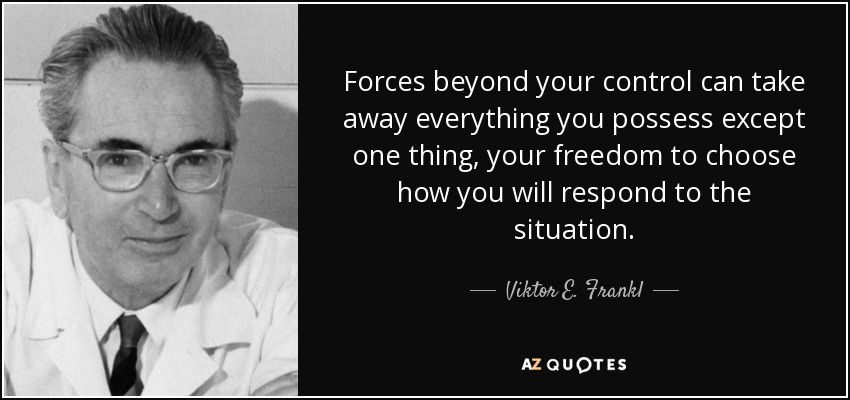
Again however, it was due to the input of my friends, families and colleagues, assuring me to take a step back and see the world around me, allowing it to spin without me for a brief moment, that I was able to successfully navigate the interviews and come out the other side. This ability to stop and put space between a thought and action, is something I have tried to practice constantly throughout the last 12 months of my life. This is mostly due to reading and learning about the late great Viktor Frankl. I often use his words to steady my mind and challenge my process, remembering in particular his quote:

Between stimulus and response there is a space. In that space is our power to choose our response. In our response lies our growth and our freedom.

Viktor Frankl

Looking to the future, the end point of this academic year is still obscured a great deal by the new challenges I will face. Whether it’s the intensifying master’s schedule, the beginning of my work at SLaM and The Loss Foundation, or the potentially draining and rigorous DClinPsy application process, there are certainly a number of things that will create a whole new set of challenges for term 2. What I can take great comfort in however, is the knowledge that I am surrounded by exceptional human beings in every aspect of my life, and that through practicing some of what Viktor Frankl says in allowing myself time and space, I can allow myself to be free of many mental restraints and be allowed to grow.

I want to say a massive thank you to everyone that has read, liked, commented on and shared my blog in 2019, and would like to wish everyone a peaceful and reflective festive season! I hope that despite the many challenges we all face, you too are able to find personal strength and growth in the coming year.

Writing the lines to read between: How science fell on it’s own sword

So, despite previous promises, it’s been well over a month since my last blog post and it’s safe to say that in that time an enormous amount has happened! Not only am I almost 1/3 of the way through my Masters in Global Mental Health, but i’ve also graduated, moved flat and applied to continue studying after my masters!

One thing that has been on my mind throughout the last few weeks of my course however, is the topic this blog post is based around.

For years now, science has come under increasing scrutiny, as its validity and place in society has been rigorously questioned by every person it influences. The most frustrating part of this situation however, is perhaps the fact that it is almost entirely self inflicted and also something that many scientists are still ignorantly trying to ignore.

For me, the moment at which I realised that science was no longer being held in such high regard by the general public, was when I watched the current Duchy of Lancaster (the then Justice Secretary) Michael Gove say that people “no longer trust experts” when being interviewed in June 2016. This, for me, seemed utterly ridiculous! How could people NOT trust experts I thought, they are literally the top of their field for a reason. Fast forward a few years, and a whole lot of political chaos later, and it’s clear to see that Gove was actually speaking some truth. Not only can this distrust be seen through the horrifying rise in easily vaccinated against communicable diseases, as the Anit-Vaxxer movement has spread, but also across the field of Global Mental Health and every other field of science.

One of the biggest problems with this enormous rise in anti-expert opinions is the fact that it is completely self inflicted. The obsession that science, and more recently mental health workers in particular, have with evidence based practice, something that was once the crowning glory and Holy Grail of all science, has soon become the sword on which the field has fallen. Take the anti-vaxxer movement for example, had it not been for the publication of the paper from Andrew Wakefield (the now discredited British Psychologist), which linked the MMR vaccine to autism, it is arguable that the anti-vaxxer movement may never have occurred. This may have then meant that the subsequent resurgence of previously eradicated diseases would have remained just a nightmare. Because the paper contained “statistical” evidence however, and of the growing obsession medical and research journals have with publishing controversial and “exciting” new research, the paper was somehow published, before quickly being redacted and discredited. How then, do scientists manage to convince the general public that they have any credibility therefore, when they had to discredit one of their own for making errors they didn’t realise until it was too late? They can’t.

Not only has this abuse of science led to the publication, and subsequent removal of hundreds of false papers, but it has also severely damaged the public’s trust in the field itself. This lack of trust is fast becoming a prominent feature within the field of Mental Health, as (often) Western psychologists and psychiatrists still desperately try to prove themselves as “real” scientists in some form of poorly made pinocchio fantasy. This means that still, despite the dire need for new and diverse interventions, psychologists try to employ the gold standard Randomised Control Trial and evidence based practice wherever possible, often scoffing at any alternative approach as inferior. This snobbish approach however, has not stopped the change of opinions across societies as those suffering from mental health issues are increasingly turning to “alternative therapies” in defiance of the old evidence based practices.

“But we have CBT” says Dr Bob, the middle aged white male psychologist from the West, “and that’s evidence based AND based on more alternative methods of treatment”. Correct, CBT is fast becoming the main form of treatment across the West for mental health issues. It is however still hemmed in by guidelines written mostly by individuals who understand very little about the populations that are receiving the treatments. This means that, regardless of how many glossy research papers you produce, and no matter how small the p value may be, people are increasingly becoming less bothered by interventions that are created with the goal of being able to add to more statistics about how “effective” the treatment method is. Instead, increasing numbers of individuals are far more interested in interventions where they have just as much of a say in how the intervention is created and conducted.

The power is in our hands however. As scientists, it’s our job to write the lines that people read between. We have the opportunity to stop the wave of disapproval before it causes anymore damage.

How? By coming off our high horses about what constitutes evidence or not, and by finally embracing the fact that science needs to be open, accessible and flexible. We cannot simply pretend that people’s lived experience isn’t valid, just because we have a research paper and a reference list of a few hundred citations that prove them “wrong”. This is perhaps most critical in the field of mental health, where lived experience still takes a back seat when writing policy compared to the gold standard of evidence, despite the massive lack of generalisability and concrete methods of researching between mental health issues.

If we wish to break the cycle and finally build trust back up again, we have to be ready to give up some seats at the table. Not just to professionals from the East, South and North, but most importantly to those who are relying on those services and the science itself the most. Only once that has happened, and we see true diversity and equality across the field will we see trust in experts restored.

The Power of Purpose – a note on World Mental Health Day

Well, it’s been almost 3 weeks since I landed back in London, leaving behind me a paradise which now seems like a distant dream, in order to pursue a new academic avenue in the form of a Masters course. After suffering heavily from post Sri Lanka blues the previous year, I was determined to give myself enough tasks this year to keep myself occupied and thus, avoid any form of post Bali blues. This of course, has not so far worked!

Until only this morning, I had always attributed my constant desire to ram my diary as full as possible to my need to be constantly occupied. I always used to joke that, given more than 10 minutes to sit down and relax, i’d not likely get back up again for a week. It wasn’t until I attended an amazing workshop at the SLV.Global Office, led by the exceptionally gifted Positive Psychologist, Mirna Šmidt (member of The Happiness Academy & Workshop Facilitator at SLV.Europe) that I realised my desire to constantly be busy and have things to do wasn’t because i’m inherently lazy, but because I crave having a purpose.

As I began thinking about this more in depth, my mind would’t stop raking over the previous life events where I hadn’t had that sense of “busyness” or what I now know to be purpose. All of a sudden, these periods of my life, such as flat hunting at the end of first year, returning from Sri Lanka or finishing my Undergraduate amongst many other things, have started to make a great deal more sense to me in terms of understanding why I struggled so much to motivate myself. The reality is, my lack of “productivity” wasn’t due to having 10 minutes to sit down, but was due to a lack of purpose and the subsequent knock on effects that had on my own happiness.

Although this World Mental Health day is themed around Mental Health promotion and Suicide Prevention, I really felt after trying to further understand my own struggles, that so much can be achieved by giving an individual a sense of purpose, ourselves included.

Something I feel I am hearing more and more frequently, especially within the context of listening to my fellow MSc Global Mental Health colleagues at KCL and LSHTM and my old and new colleagues at SLV.Global, is the need to empower service users to the point that they feel validated, relevant and that they have a purpose within life. Despite this awareness and passionate goal however, there is still a worrying amount of people, especially mental health professionals not practicing what they preach, something I commonly fall foul of.

Referring back to the workshop I mentioned earlier with Mirna, another key component she highlighted when discussing the meaning of happiness was the need for gratitude, not just towards others but also to ourselves. Again, this is something I feel is very commonly discussed, whether that’s in the classroom, on the way home or even abroad on volunteer/work placements, but seldom practiced, either by mental health professionals or those who advocate for following said practices.

So, this World Mental Health Day, and for every day that follows, I would like to challenge you, yes YOU to find the purpose in everything you do. And once you have found that purpose, be GRATEFUL for it! Having the ability to discover why we do things and how that serves both our present and future selves is a skill that all should practice, and something I will personally be pushing myself to do wherever possible.

Only once we as individuals have gained this understanding of our own purpose and have truly expressed gratitude towards ourselves for everything we do, is it possible, in my opinion, for us to empower other individuals to do the same.